Blog
Blind
Why did you write How to Get a Graduate Job in a Pandemic?
Because the Class of 2020 are crying out for help. I’m not going to lie – this is a particularly tough year to be joining the job market. Covid has turned entire industries upside down, and it’s not yet clear what a post-pandemic world will look like. Graduates need help understanding what all this means for them, so they can assess their options and make a plan – even if it’s just for the next six to 12 months. To write this book I drew on what I’ve learned running my website Graduate Fog for ten years, campaigning for good jobs (and paid internships) for young people, and running the Good + Fair Employers Club, where I facilitate conversations between the UK’s best firms for young people to work for.
In the book, I also explain the various methods of job hunting and the difference between being flexible and being desperate! And I repeat my mantra over and over: If it’s not working, stop doing it – and try something else that might work. It kills me to see graduates submitting the same CV to the same jobs they’ve seen on the same websites, week after week, and hearing nothing back. If you’re stuck in that ‘scatter gun’ cycle and feeling increasingly miserable, please stop what you’re doing and read my book!
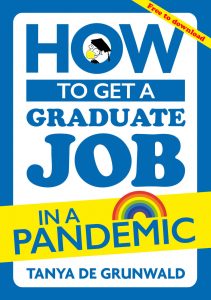
How to get a graduate job in a pandemic
Is it harder for disabled graduates to find a job this year?
It is harder for all graduates to get a job this year – but not for the reasons you might think. It may feel like there is a conspiracy against you, with employers pulling up the drawbridge and slashing entry level jobs to save money, but that’s not really what’s happening. Most companies have simply had to prioritise staying afloat, so creating lots of lovely junior jobs has not been at the top of their to-do list. Also, there may not have been much work for you to do while they sorted themselves out, and moving internships, assessment centres and interviews online is harder to organise than you think.
The good news is that every firm needs the energy and ideas that young people bring, and in fact, junior salaries are relatively cheap so I expect recruitment to pick up as 2021 gets going. For disabled graduates specifically, I’d say it is better that Covid happened now rather than five years ago, as employers are more interested in disability and difference than ever before. Of course, many still have a long way to go – I’m just saying that I’ve noticed an increase in appetite for educating themselves, and doing more to be genuinely inclusive of everybody who wants to work for them.
What are your tips for disabled graduates looking for a job this year?
Seek out the most enlightened employers in your chosen field. The most switched-on firms will want to hear from you. Diversity and inclusion have been talked about so much lately, and companies really are doing more – it’s not just talk, or for PR. They can’t say they care about diversity, and ignore disability. The articles we have published on Graduate Fog for disabled graduates are some of the most popular pages on the website, which gives me a sense of how poorly served this community is. I’m so pleased that Helen [Cooke CBE, founder of My Plus Students’ Club] has agreed to speak at a session for our Good + Fair Employers Club in 2021, so she can show our member firms how to do better on disability and difference.
One more piece of advice to disabled graduates: Take care of yourself, and your mental health. I wrote a whole chapter in How to Get a Graduate Job in a Pandemic about confidence and motivation, as it’s such a neglected aspect of job hunting. It’s annoying when people say cheerfully: ‘Treat your job hunt like a job!’ In reality, that’s really hard to do. We’re not robots!
Do you have any of your own experience of disability?
Not many people know that I have what’s called an ‘interiorised’ stammer (or stutter). Similar to Ed Balls and Joe Biden, I am very fluent most of the time, and most speech situations are not a problem for me. I am also able to hide my disfluency by switching words or not speaking when I think I might stammer. However, that can produce other problems as people don’t know that I stammer at all, so when I go through a less fluent period it can be stressful for me. Talking about this openly right now is a positive step for me actually, so thanks for asking that question so I can be a bit more ‘out’! For me, non-verbal communication is really helpful, so I like Zoom, in-person meetings and even giving presentations. What trips me up is the phone, or buzzer entry systems. I hate shouting at a wall! When going to interviews, I was always more worried about getting into the building than I was about the interview itself, so I’ve had a tiny taste of what it’s like juggling an extra challenge when applying for jobs.
How to Get a Graduate Job in a Pandemic is available to download for free here: How to Get a Graduate Job in a Pandemic
 Tanya de Grunwald is a campaigner for good jobs and fair pay for young people. She is the founder of the graduate careers blog Graduate Fog, best known for challenging Tony Blair, Simon Cowell and Philip Green for having unpaid interns. She is also the founder of the Good + Fair Employers Club, a coalition of the UK’s best firms for young people, including Google, Channel 4 and Santander. Tanya’s new e-book How to Get a Graduate Job in a Pandemic is out now and free to download.

“The Explore the Law careers event was an excellent experience and gave me motivation to apply to some firms I initially didn’t think about.”
EmiliaTo follow this employer join the MyPlus Students' Club
To save this content, join the MyPlus Students' Club